One hub. Every service your venture sells.
do.place is a hub with a catalog. Your tenants browse it, order from it, and get working services under your brand — while you decide what's on the shelf. New services are declared, not developed: describe what the service is, who may see it, what it costs, and the platform does the rest.
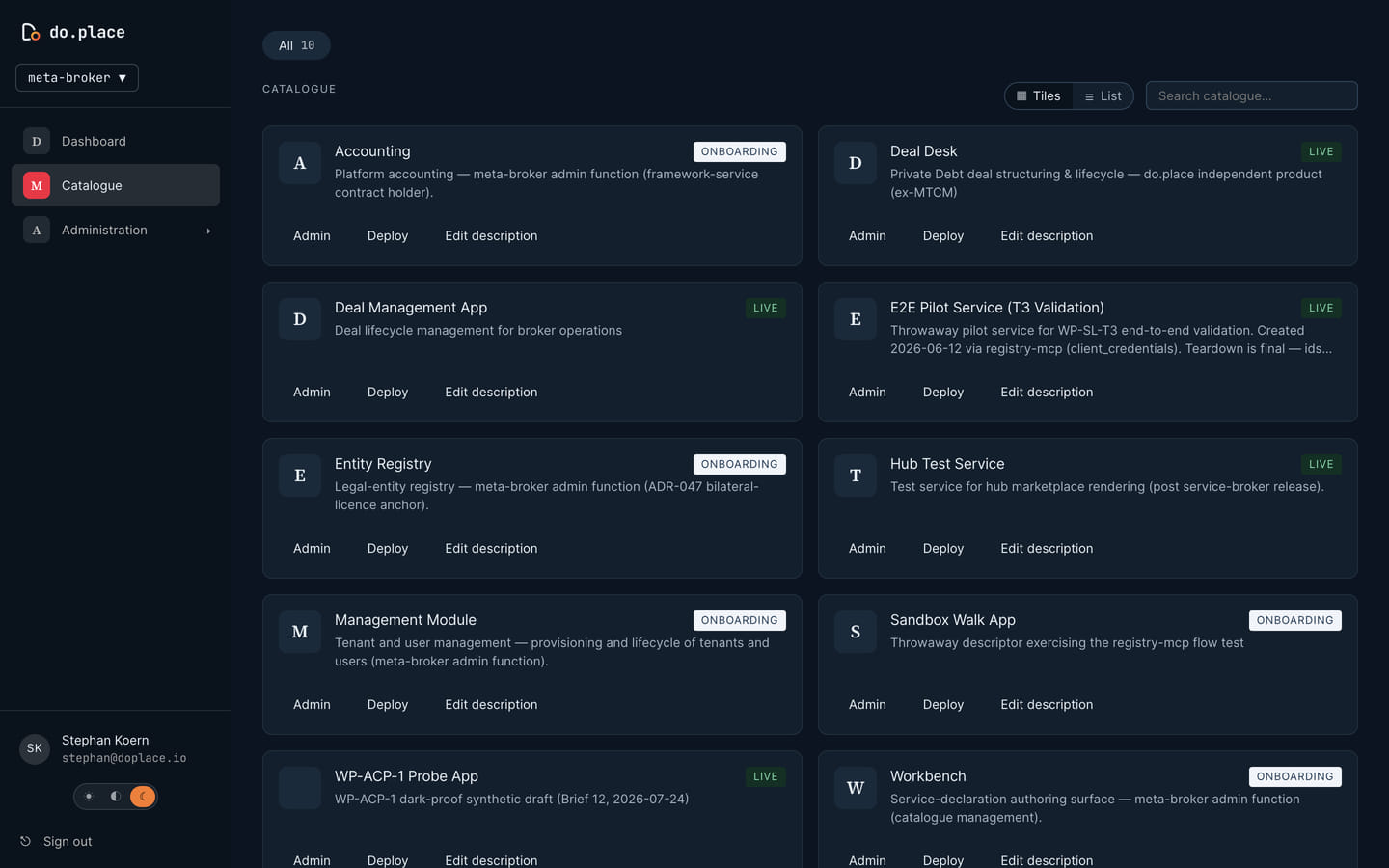
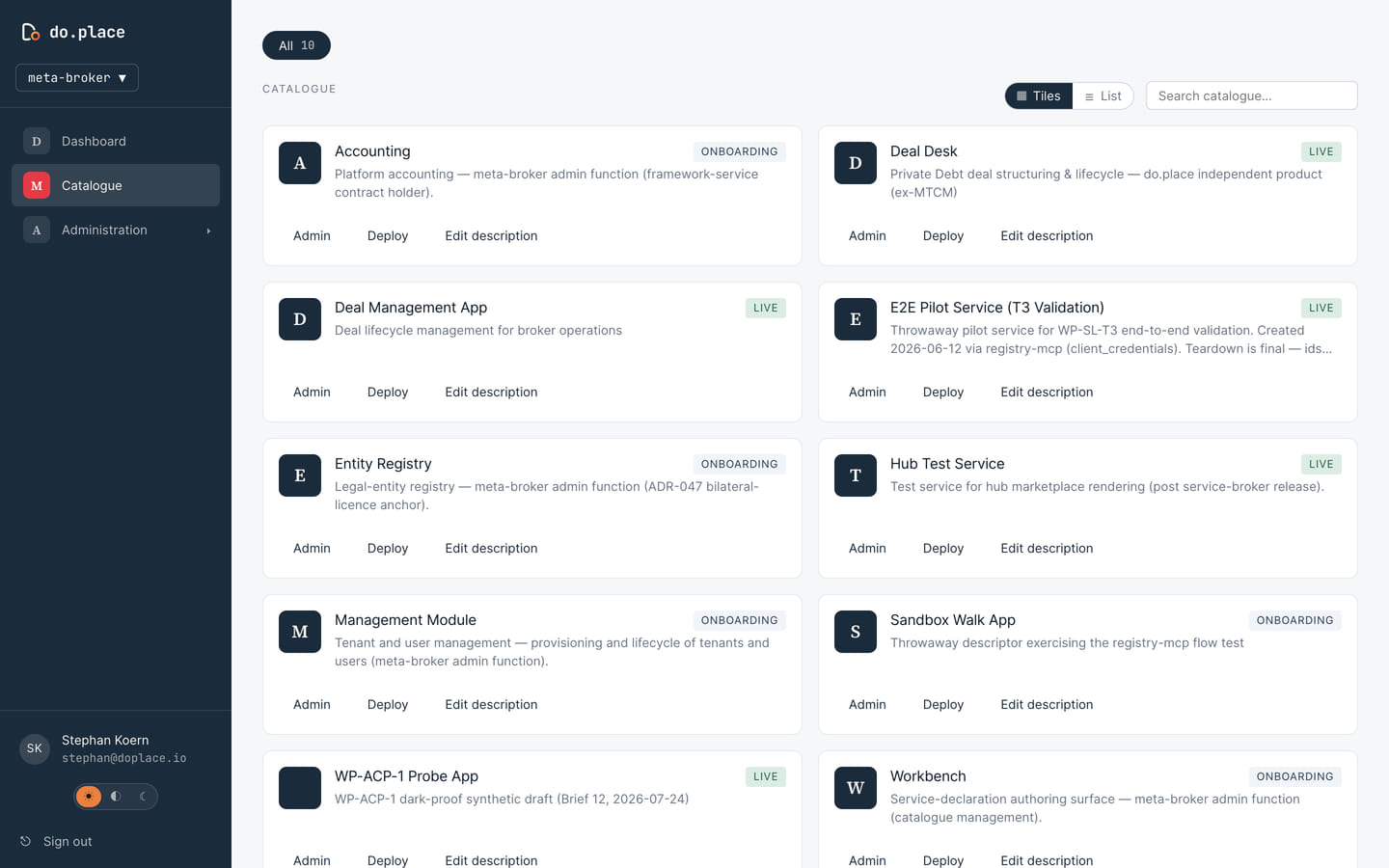
your shelf, your rules.
You decide what's in the catalog, who sees which tile, and what ordering means — approval flows, provisioning and billing follow your declaration.
declared, not developed.
A new service is a declaration in the Workbench, not a development project. The gap between “we should offer this” and “customers can order this” is configuration.
everyone signs with us.
Every participant — you, your partners, your tenants — holds their own contract with do.place, anchored in the Entity Registry. Nobody operates anybody else's infrastructure. how that works →
a catalog your customers can act on.
Not a brochure — every tile is orderable, and ordering does something: provisioning, access and billing start from the declaration.
- public and private tiles — who sees what is a setting, not a build
- ordering with meaning — approval, provisioning and billing wired to each service
- your brand on the venue, your name on the relationship
services declared in the Workbench.
The Workbench is where a service becomes real: identity, audience, commercials, lifecycle — authored as a declaration.
- one declaration carries the service through catalog, ordering and operation
- change the declaration, change the service — no release train
- proven on itself — Deal Desk, the registry and the hub's own admin functions all run this way
tenants, users, entities — kept straight.
Multi-party ventures die of “who is this and what may they do.” The platform carries the answer.
- tenant and user lifecycle managed from the hub
- an entity registry that anchors each participant's contract
- one identity across every tile
asked, answered.
is this real or a deck?
Real. The screenshots on this site are the running hub. Deal Desk, the first catalog product, is in production use. We're in private alpha — the honest description of everything else.
what does “declared, not developed” actually mean?
A service on do.place is a structured declaration — what it is, who may order it, what it costs, how it provisions. The platform interprets the declaration. There is custom code inside products like Deal Desk; there is none between a declaration and a working catalog entry.
what if we outgrow you?
Your data is yours and leaves in open formats, and every service is described by its declaration rather than buried in code. Portability is part of the architecture, not a negotiation. more on the technology page →
see your services on the board.
private alpha · we reply within 2 business days.